

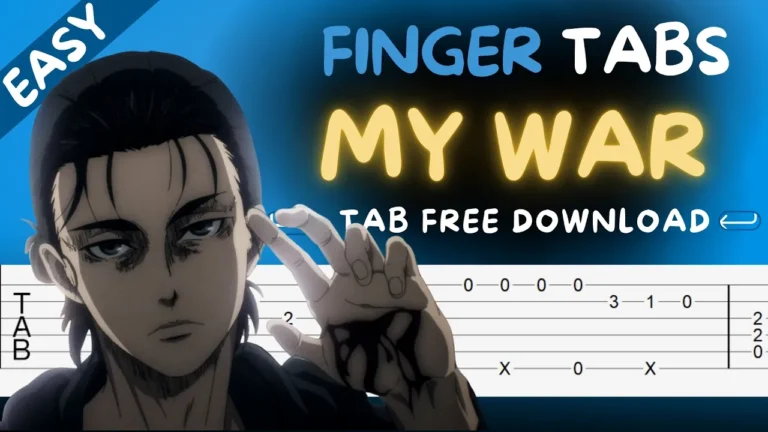
How To play: My War – Attack on Titan
My War – Attack on Titan
This arrangement of My War (Boku no Sensou) really stands out for one reason: it forces you to think ahead while playing. It’s not just about the notes, but about how the music evolves—and even how your setup changes in the middle of the performance.
If you follow the idea correctly, the piece becomes much more manageable than it first appears.
Arrangement Overview
The first thing to understand is the capo.
You’ll start with the capo on the 4th fret. After a certain point in the song, the music rises by a half step. That means you’ll need to move the capo to the 5th fret during the performance. It’s not common, but it’s part of what gives this arrangement its character. Watch the transition carefully and practice it separately.
Harmonically, everything is based on simple chord shapes. Even though the actual key is closer to E major or C#m, you’ll be using familiar forms from C major. That keeps the left hand comfortable and avoids unnecessary complexity.
The melody stays mostly on the first and second strings (E and B), which makes it very accessible and easy to locate on the guitar.
Technique
The left hand is not the problem here.
The chord shapes are simple, and most of the work happens within familiar positions. You’re basically playing arpeggios over shapes derived from C major or A minor forms.
The right hand is where things get serious.
The rhythm is fast, and the piece relies on a steady 4/4 groove combined with percussive elements. You need a solid fingerpicking foundation to keep everything under control.
Slides are also very important. They represent the intensity of the melody—almost like vocal “shouts.” Don’t play them softly. Press firmly and make them clear, even if it feels demanding on your fingers. That extra pressure is what gives the note its character.
Musical Insight
This is not a calm piece.
The music represents tension, chaos, and movement—almost like a battlefield. Because of that, dynamics matter a lot.
When the intensity drops, it feels like the chaos is fading. When it comes back, it needs to hit hard. That contrast between softer and more aggressive playing is what makes the arrangement feel alive.
Another important detail is the pause near the end. After a fast and intense section, the silence creates a strong impact. Don’t rush through it. Let that moment breathe.
Practice Tip
Work in layers.
Start with the capo on the 4th fret and focus only on the chord shapes and melody. Don’t worry about rhythm or percussion yet.
Once that feels clear, move to the arpeggios. Understand how each section flows before trying to connect everything.
After that, begin adding the right-hand percussion. Keep it controlled. Even though it’s energetic, it should not overpower the arpeggio.
A good progression is:
- Chords + melody
- Chords + melody + arpeggio
- Full arrangement with percussion
And don’t forget to practice the capo change. That moment needs to feel natural, especially after the slide that leads into the pause.
Extra Details
Stay aware of the tonal center. Even though you’re using simple shapes, the sound is rooted around C#m or E major. The capo is what makes this possible without complicating the fingering.
Also, pay attention to the final fast section. The pauses there are very expressive. They give the feeling that something intense has suddenly stopped.
And most importantly—don’t underestimate the capo change. It’s a small detail, but it defines the arrangement.
Download free tabs using the button below: